MPA Series: If the Economy Is ‘Growing’, Why Does It Feel So Bad?
Maybe the problem isn’t you. Maybe it’s what we choose to measure.
Let’s be real. Economics has always felt confusing — almost as if it was designed to be. Charts, equations, forecasts, invisible hands… a language that sounds objective but somehow leaves most of us out of the conversation. I’m not an economist, and I wasn’t trained in the discipline, yet “the economy” has shaped everything around me: what I can afford, how I live, the choices I make, and the limits I bump into every day.
This post comes from the very first paper I wrote during my MPA at UCL IIPP, in a class called New Economic Thinking. It wasn’t a course about equations or modelling; it was about the stories, ideologies, and schools of thought that built the economic world we live in.
As I dug into Keynes, Schumpeter, Marx, and the dominant neoclassical paradigm that insists growth is endless and self-correcting, I started noticing a pattern running beneath them all — a quiet politics about who wins, who doesn’t, and whose lives get counted as “the economy.”
Maybe the mainstream narrative about growth isn’t entirely wrong. But maybe the reason so many of us don’t feel its benefits is because our growth is pointed in the wrong direction.
You’ve probably heard some version of this line lately:
“The economy is strong. Growth is up. Unemployment is low.”
And yet, in the same week, you might also say:
“Rent just went up again” “Groceries cost more than last month”
“You’re working harder but somehow feel more precarious” “Climate disasters are now a season, not a surprise”
You’re not alone in feeling that disconnect.
Recent global surveys show a majority of people believe the system is rigged in favour of the wealthy, and that government and business leaders are making their lives harder, not better. In one summary of global polling, 61% of people across 26 countries reported moderate to high grievance and see elites as serving narrow interests; two-thirds think leaders and media are actively misleading them.
Meanwhile, middle-class incomes have barely moved in many rich countries, even as the costs of housing and basic services have raced ahead. And at the very top, the richest 1% of people now own close to half of the world’s wealth, and have captured tens of trillions of dollars in new wealth over the past decade.
So if “the economy” is supposedly doing fine, but most people feel squeezed, anxious, and left out…
maybe we need to ask a harder question:
“Is our economic system focused on the wrong thing?”
The scoreboard we inherited
For about 80 years, the world has relied on one main scoreboard: GDP — Gross Domestic Product.
GDP adds up the value of all final goods and services produced in a country over a period of time. It was developed in the 1930s and 1940s, in the wake of the Great Depression and during World War II, as governments needed a tool to plan production and answer questions like: How much can we produce? How much can we tax? How much can we spend on war without collapsing the home front?
Simon Kuznets, one of the architects of national income accounting, actually warned against treating GDP as a measure of national wellbeing. But over time, that caution got lost. GDP became the headline number:
Politicians run on it.
Global institutions benchmark countries against it.
News outlets treat quarterly growth like a health check.
The problem? GDP is very good at answering one narrow question:
“How much are we producing?”
It is terrible at answering the questions that most of us wake up with:
“Can I live a decent life?”
“Is my community secure?”
“Will my kids inherit a livable planet?”
GDP doesn’t care if that growth comes with burnout, depression, or 60-hour weeks. It doesn’t know if forests were cleared or rivers poisoned. It doesn’t see unpaid care work at all. A flood that destroys homes and forces a costly rebuild? That can increase GDP.
From a distance, it looks like progress. Living through it feels very different.
Economics was never neutral
For a long time, economics sold itself as a kind of physics for money: neutral, objective, above politics.
But zoom out, and you see something else.
The way we define “the economy” has always been political:
In feudal Europe, it was mostly about land, grain, and tithes.
Under mercantilism, it was ships, silver, and colonies.
During industrialisation, it became factories, machines, and waged labour.
In our current era, it’s global finance, intellectual property, and digital platforms.
Each shift didn’t just describe reality — it redefined what counted as valuable.
Institutions like the IMF and World Bank were built in the mid-20th century on assumptions about what “sound economics” looks like: tight monetary policy, open capital markets, limited state intervention, export-oriented growth. Critiques today point out that these institutions still reflect power imbalances, often giving richer countries more say, and pushing policies — like austerity and privatisation — that serve creditors more than ordinary people.
So when we say “the economy is doing well,” we’re really saying:
“The things our current paradigm cares about are doing well.”
The question is: are those the things that matter most?
The Iceberg economy
When I was writing the original academic paper behind this piece, one image kept coming back: an iceberg.
Above the waterline is the “official” economy — the things we count and celebrate:
Tech IPOs
Factory output
Financial assets
Consumer spending
Quarterly earnings
Below the surface lies everything that makes those numbers possible:
Unpaid care work — mostly done by women and girls — cooking, cleaning, caring for children, elders, sick relatives.
Informal work — from street vendors to gig workers whose livelihoods never appear in national statistics.
Ecosystems — forests, oceans, soils, pollinators quietly doing trillions of dollars worth of work for free.
Communities — mutual aid, neighbourhood support, social ties that catch people when markets and states fall short.
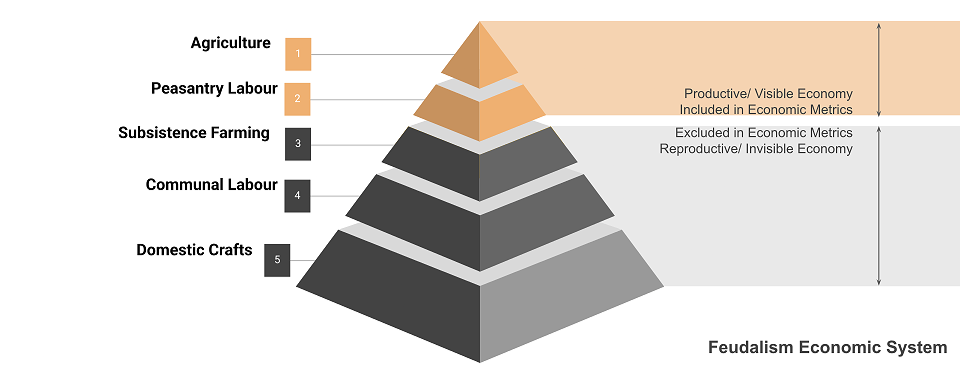
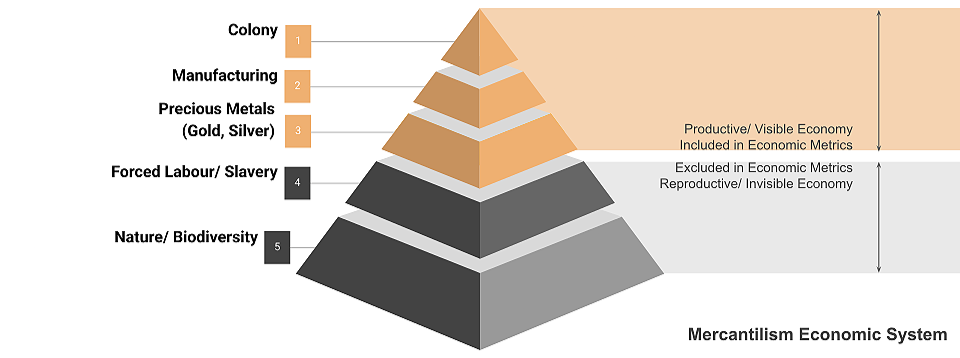
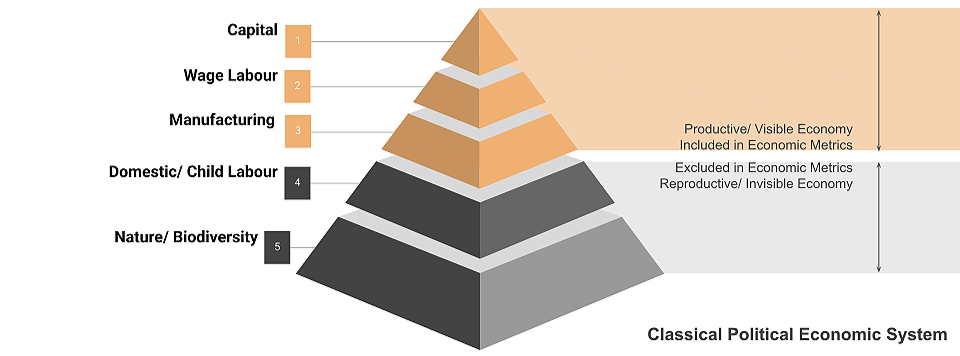

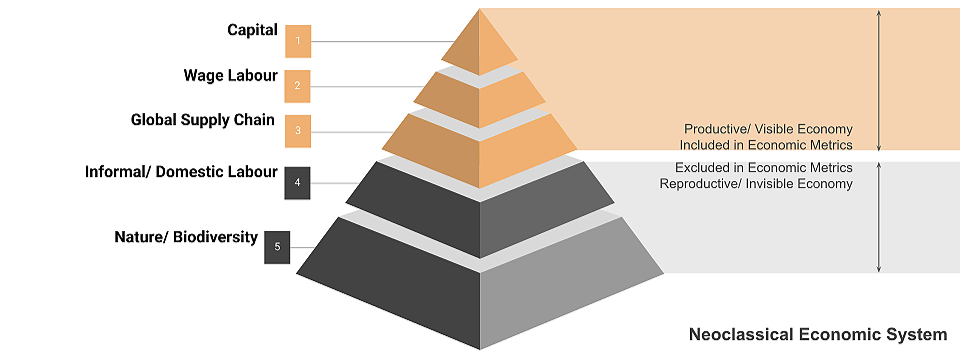
Global estimates suggest that unpaid care and domestic work could be worth trillions of dollars a year if it were paid at market rates — as high as 40% of GDP in some economies. Yet in our main economic scoreboard, it is valued at zero.
In other words, we’ve built a system that treats the visible tip of the iceberg as “the economy” — and everything it rests on as an afterthought.
But your body, your relationships, your mental health, your community, and your environment know better.
When the scoreboard drives the game off a cliff
Here’s where it becomes a systemic problem.
What we measure doesn’t just describe the world. It steers it.
If governments are judged on GDP, they will chase activities that boost GDP — even if these deepen inequality or ecological damage.
If companies are rewarded for short-term profits, they will seek efficiency by cutting labour costs, offshoring risks, and externalising pollution.
If global institutions treat “stability” as protecting financial markets, they will often push the costs of adjustment onto workers and public services.
This is how we get:
Rising inequality even in growing economies.
A middle class that feels squeezed as wages stagnate while productivity rises and asset prices soar.
A climate and biodiversity crisis driven by a model that sees nature primarily as an input to production or a cost to be discounted.
If you feel like you’re running faster to stay in the same place, it’s not a personal failure.
You’re living inside an economic story that was built for a different era, serving a thin slice of reality.
Experiments from the edges
The good news is: people have been trying to rewrite the script for years.
A few examples that influenced my research:
Bhutan’s Gross National Happiness (GNH) shifts the focus from output to wellbeing — tracking things like psychological health, time use, culture, and ecological resilience alongside income. It’s imperfect, but it sends a clear signal: happiness is not a side-effect; it’s an objective.
The Genuine Progress Indicator (GPI) starts from economic activity, then subtracts things like pollution, resource depletion, crime, and inequality. In this view, clearing an oil spill is not a “win” for the economy.
New Zealand’s Living Standards Framework and its much-discussed Wellbeing Budgets explicitly ask: how do spending decisions affect mental health, child poverty, social connections, and the environment — not just GDP?
None of these models are perfect. All of them are political.
But that’s the point: they admit that economics has always been political.
During my MPA, I tried adding to this evolving toolbox by sketching something I called the Sustainable Livability Index — an attempt to bring together environmental health, social equity, care work, informal economies, and basic material security into a single picture of “how livable is this place, really?”
Do I think it’s the solution? No.
Working on it actually convinced me that there may never be a single, magical, universal metric that captures everything that matters.
And maybe that’s okay.
It’s bigger than one new index
It would be convenient if we could just swap GDP for a shinier new acronym and declare the job done.
But what we’re really up against is deeper:
A habit of treating people as inputs to production, rather than ends in themselves.
A worldview that assumes more consumption is always progress.
A political economy where a small minority can accumulate and protect huge pools of wealth while others are told to tighten their belts.
New metrics — whether GNH, GPI, wellbeing budgets, or a livability index — are tools.
They matter because they help us ask different questions and see neglected realities.
But we still have to do the harder work:
Challenging who gets to define “the economy.”
Naming whose experiences have been treated as noise.
Rebuilding institutions so they serve public purpose, not just private balance sheets.
So where does that leave us?
Instead of ending with a neat policy checklist, I’d rather leave you with a few questions to sit with — as a citizen, a worker, a carer, a neighbour:
What are the parts of your life that never show up in any statistic, but without which everything would fall apart?
When you hear “the economy is doing well,” does that match how things feel in your home, your workplace, your community? Why or why not?
If your city or country changed its main goal from “grow GDP” to “improve livability,” what’s the first thing you’d expect to see change?
Who do you think has benefited most from the current setup — and who has had to quietly absorb its costs?
If you could redesign the scoreboard, what would you insist on counting? Care? Time? Safety? Ecological health? Dignity?
The widespread discontent so many of us feel isn’t a glitch.
It’s feedback.
It’s our lived experience telling us that the story we’ve been using to organise economic life is too narrow, too extractive, and too blind to what actually makes a life worth living.
Maybe the first step isn’t to fix “the economy” as it’s currently defined.
Maybe it’s to tell a bigger, truer story about what an economy is for — and then slowly, stubbornly, start building systems that live up to it.