MPA Series: When Cities Fall Apart, It’s Never Just One Thing
Why urban decay isn’t an “urban planning problem” — and why our solutions need to get braver.
The Myth of the Single-Domain Fix
Urban problems are rarely what they appear to be on the surface. We’re taught to think of traffic, flooding, slums, crime, pollution, and congestion as technical or spatial issues — things for architects, planners, or engineers to solve with better roads, new zoning, or more infrastructure. That belief is comforting because it offers simple villains and simple fixes.
But after taking a class called Power, Politics, and Systems Change during my MPA at UCL IIPP, I realized something uncomfortable:
what looks like an “urban problem” on the street is usually the end result of dozens of other systems failing quietly in the background.
And once you start seeing cities this way, you can’t unsee it.
This post is based on a paper I wrote for that class. It was personal work for me — a return to my roots training in architecture, and growing up in Manila, but with a bigger lens. It pushed me to rethink the way we diagnose urban decay. What if the traffic you’re stuck in isn’t just a transport issue? What if the slum you pass on your commute isn’t just a “housing deficit”? What if the city you live in is only as strong as the hidden systems underneath it — the economic, psychological, environmental, and political forces that quietly hold it together or slowly tear it apart?
Urban decay always feels personal — because it is
If you’ve lived in any big city in the Global South, you’ve probably lived some version of this story:
You wake up at 4:00 AM for a commute that should take 20 minutes but somehow takes two to three hours. You pass neighborhoods where kids dodge cars on roads with no sidewalks. You smell the heavy traffic fumes that make the air thick even before sunrise. And you watch the city unfold through your window — the slums, the traffic deadlocks, the heat, the noise — all feeling strangely connected but never spoken about together.
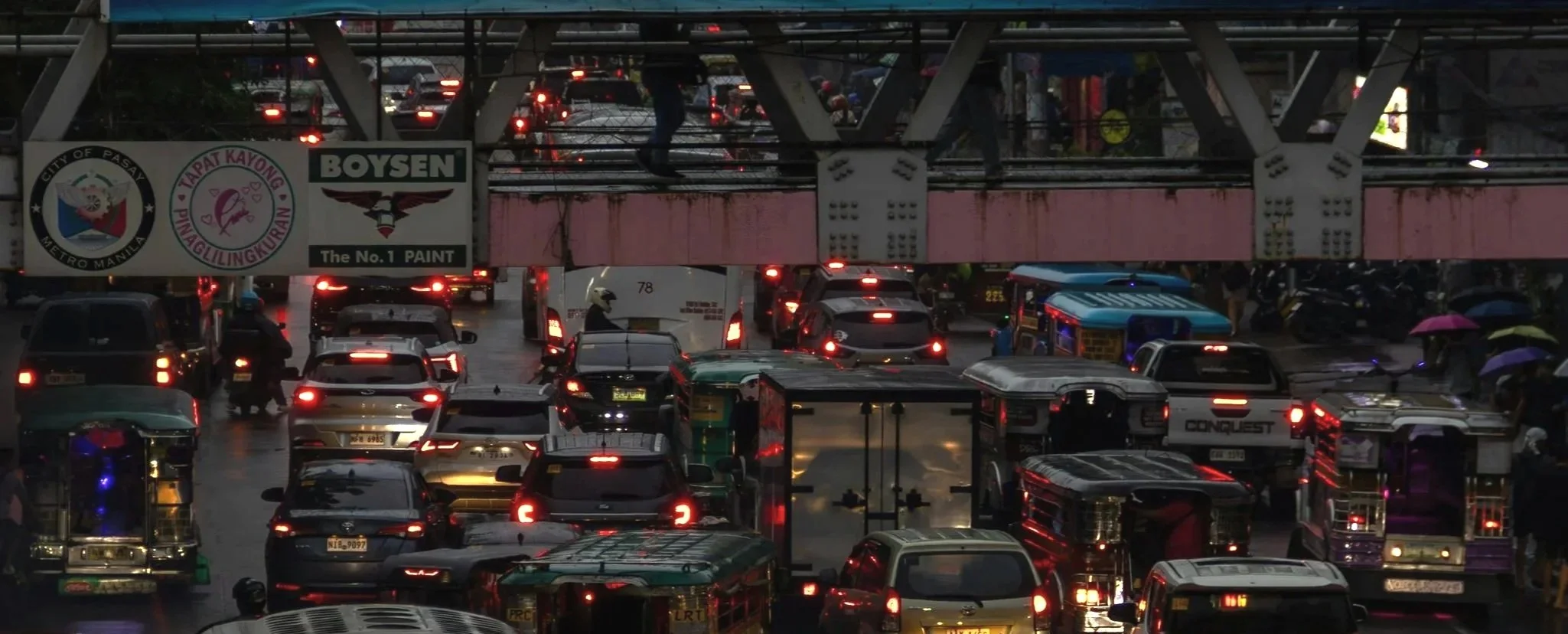
This was the story of Manila that I explored in my paper — a city where the daily commute becomes a reminder that urban design, inequality, transport, crime, heat, pollution, and opportunity are not separate chapters. They’re one tangled book.
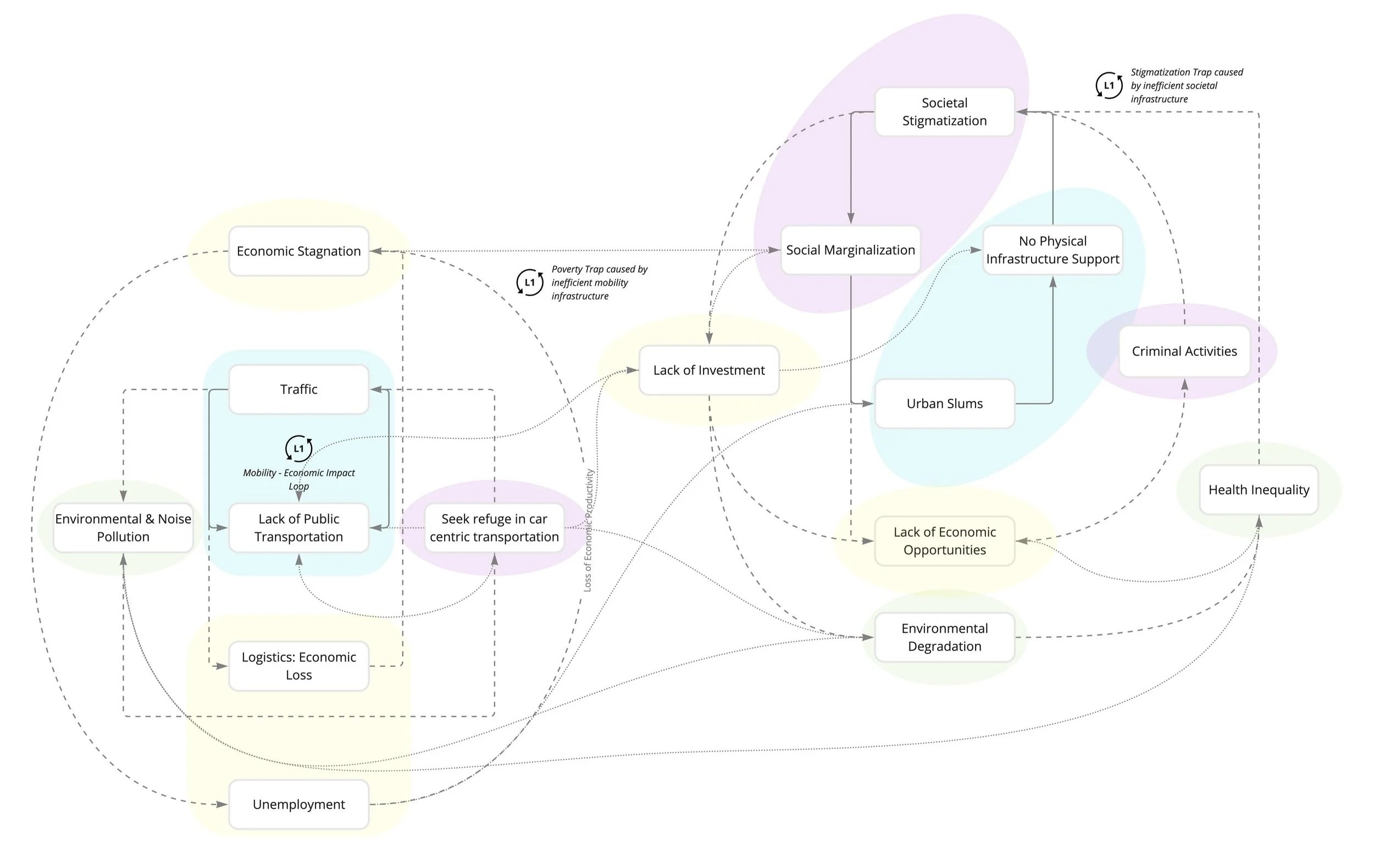
As I started mapping Manila’s systems — literally drawing out loops, arrows, nodes, and feedback cycles — the picture became clearer:
cities don’t fail because one system collapses. They fail because many systems collapse together.
And when they do, people feel it in ways infrastructure alone can’t capture.
The trap of thinking in silos
We’re comfortable with the idea that one discipline should solve “its own” problem:
Traffic? Transportation engineers.
Crime? Law enforcement.
Pollution? Environmental agencies.
Slums? Housing and land use planners.
Heat islands? Climate people.
Economic stagnation? Economists.
Mental health issues? Public health professionals.
This is how governments organize themselves.
It is also how they get stuck.
In Manila, mobility isn’t just a transportation issue — it’s an economic problem (lost productivity), an environmental problem (heat islands and emissions), a social problem (inequitable access), and even a psychological one (stress, safety, stigma) all at once. And urban slums like BASECO aren’t just housing problems — they’re products of history, poverty, stigma, spatial exclusion, policy neglect, and broken feedback loops that reinforce one another over time.
Yet our institutions — and often our imagination — treat these as separate things.
It’s like trying to fix a sinking boat by patching one hole while ignoring the others… and the fact that the boat engine doesn’t work… and you’re steering into a storm.
When you zoom out, the “urban problem” stops looking urban
One of the most eye-opening moments in this research was realizing that urban decay doesn’t start in the streets. It starts in:
budgets political agendas land markets
enforcement gaps underinvestment
cultural perceptions inequality traps spatial stigmas institutional silos
Cities are the physical symptoms of choices made far upstream.
For example:
Traffic congestion isn’t just too many cars — it’s poor economic planning, political incentives that reward road-building over public transport, and a culture that equates cars with status and safety.
Urban heat isn’t just about missing trees — it’s the spillover of zoning laws, real estate speculation, and a transport system that traps millions in slow-moving, heat-generating gridlock.
Slums aren’t just “informal housing” — they’re communities structurally excluded from opportunity because spatial design, economics, and social stigma reinforce each other in a tight loop.
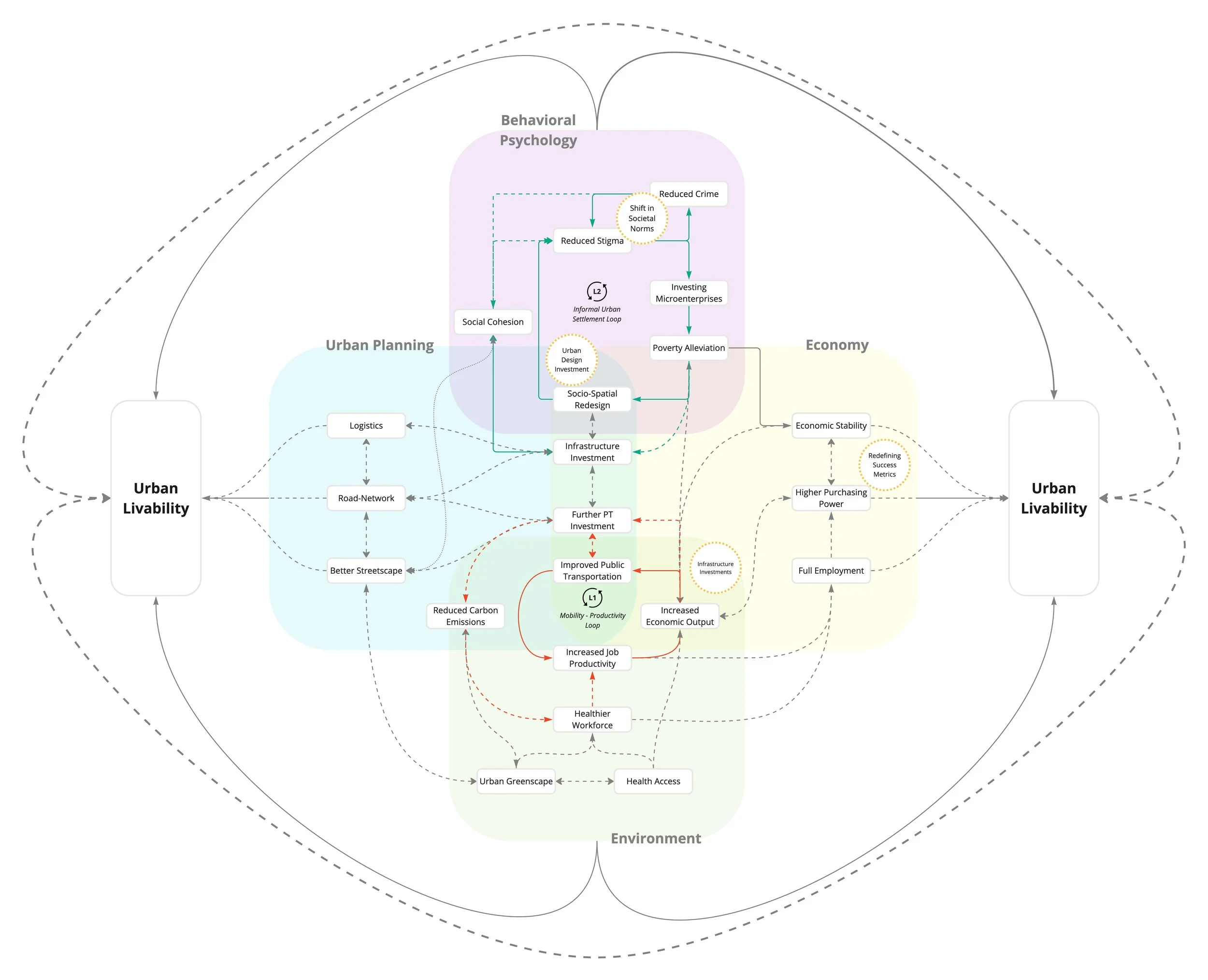
The systems maps from my paper showed these connections clearly. Once you overlay economics, psychology, planning, and environment, the city stops looking like departments and starts looking like a living organism — one where every decision vibrates across the whole system.
BASECO: A community shaped by everything except its own agency
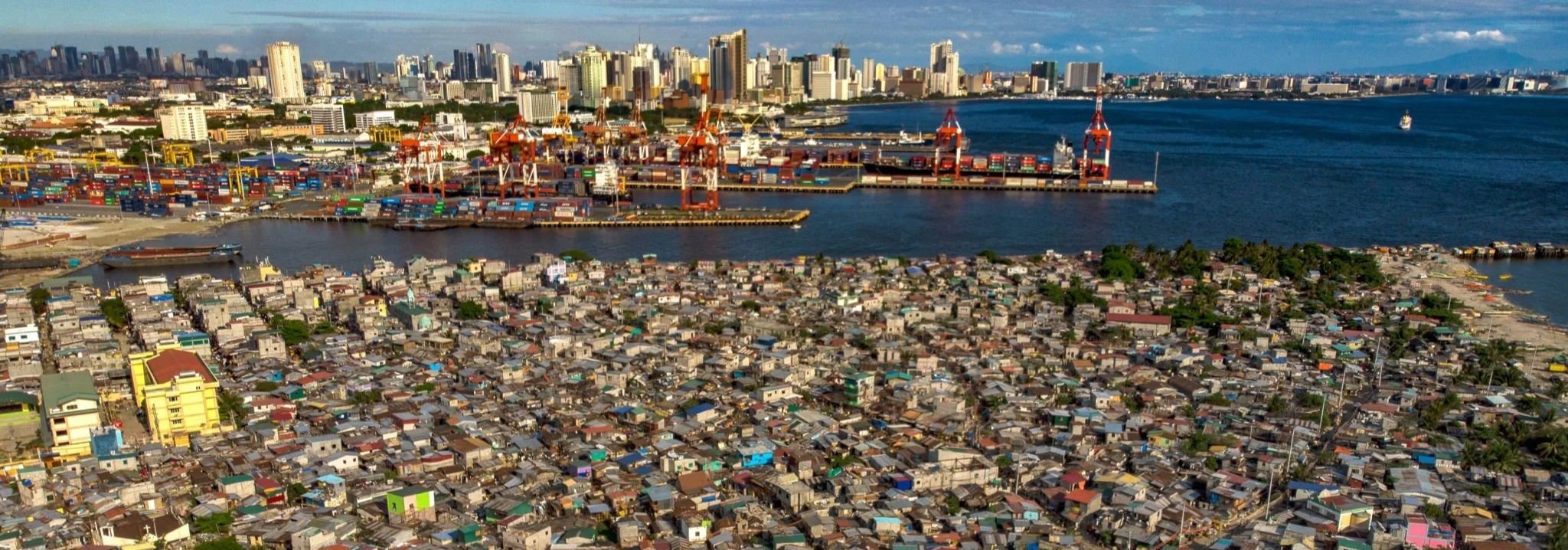
Source: Getty Images (Credit: Ezra Acayan)
One of the most painful parts of this work was looking closely at BASECO, one of Manila’s most stigmatized urban settlements. It’s easy to see slums as visual “eyesores,” but space syntax analysis showed a deeper story: narrow roads limit movement; limited public spaces choke social life; stigma creates exclusion; exclusion reduces opportunity; reduced opportunity fuels crime; crime reinforces stigma again.
A closed loop.
A trap.
A system perfectly designed to produce the outcomes we claim to want to solve.
And yet — in the data, there was also evidence that small spatial changes could shift mental models. Public squares, safe walkways, better integration with surrounding neighborhoods — these aren’t just design decisions. They’re psychological interventions. Social interventions. Economic interventions.
In a city, space is politics.
Systems thinking doesn’t give easy answers — but it gives honest ones
When I applied frameworks like Meadows’ Leverage Points and Kania’s Six Conditions of Systems Change, something clicked for me:
Most urban reforms fail not because they’re bad ideas, but because they intervene too shallowly.
We try to fix symptoms:
traffic lights, sidewalks, new bus routes, nice renderings.
But systems fail because of beliefs, incentives, narratives, power dynamics, and institutional norms — things no blueprint can fix on its own.
This class taught me that real change often requires shifting:
how we see mobility (from a commodity to a right)
how we see slums (from “blight” to communities with agency)
how we see planning (from physical design to social infrastructure)
how we see cities (from places to build things to places to build possibility)
That’s not architecture.
That’s politics.
That’s psychology.
That’s economics.
That’s systems change.
So why does this matter for anyone who doesn’t study cities?
Because we’ve all lived through dysfunction that feels like someone else’s fault — the planner, the mayor, the motorists, the commuters, “the system.” But cities don’t break down because of one villain. They break down because no one is looking at the whole picture.
And when no one owns the whole picture, everyone suffers a piece of it.
So here’s the heart of what I learned:
Urban decay is not an urban issue.
It’s a systems issue.
And systems issues demand systems imaginations.
A few questions to sit with
Instead of closing with a list of solutions, I’ll leave you with the same questions that lingered after writing this paper:
What urban “problems” have you been taught to see in isolation?
Who benefits from keeping problems siloed — and who pays the price?
What would change if we saw cities not as shapes on maps but as ecosystems of power, psychology, and possibility?
And maybe the hardest one: What if the city we want won’t come from better plans, but from braver imaginations?
If nothing else, I hope this piece nudges you to look at your own city differently — not as a broken machine needing repairs, but as a living system waiting to be understood.